· 7 min read
Types of freight fraud brokers face, and why most of them pass carrier vetting
Double brokering, carrier identity theft, fictitious pickups, phishing and fake paperwork all run on a borrowed identity that passes carrier vetting. Here's how each works, how AI removes the old tells, and why the pickup is where they are caught.

Freight fraud is any scheme that uses a false or borrowed identity to take a load, a payment, or both from a broker, shipper, or carrier. The latest numbers show where it is heading: in Q2 2026, reported cargo thefts fell from 488 to 378 year over year, but losses more than doubled to $304.6 million, and fictitious pickups held nearly flat at 158, about four in ten of all thefts (Verisk CargoNet, Aug 2026).
Fewer thefts, bigger losses, and a steady share of thieves who simply show up at the dock. That pattern says something about how these schemes work.
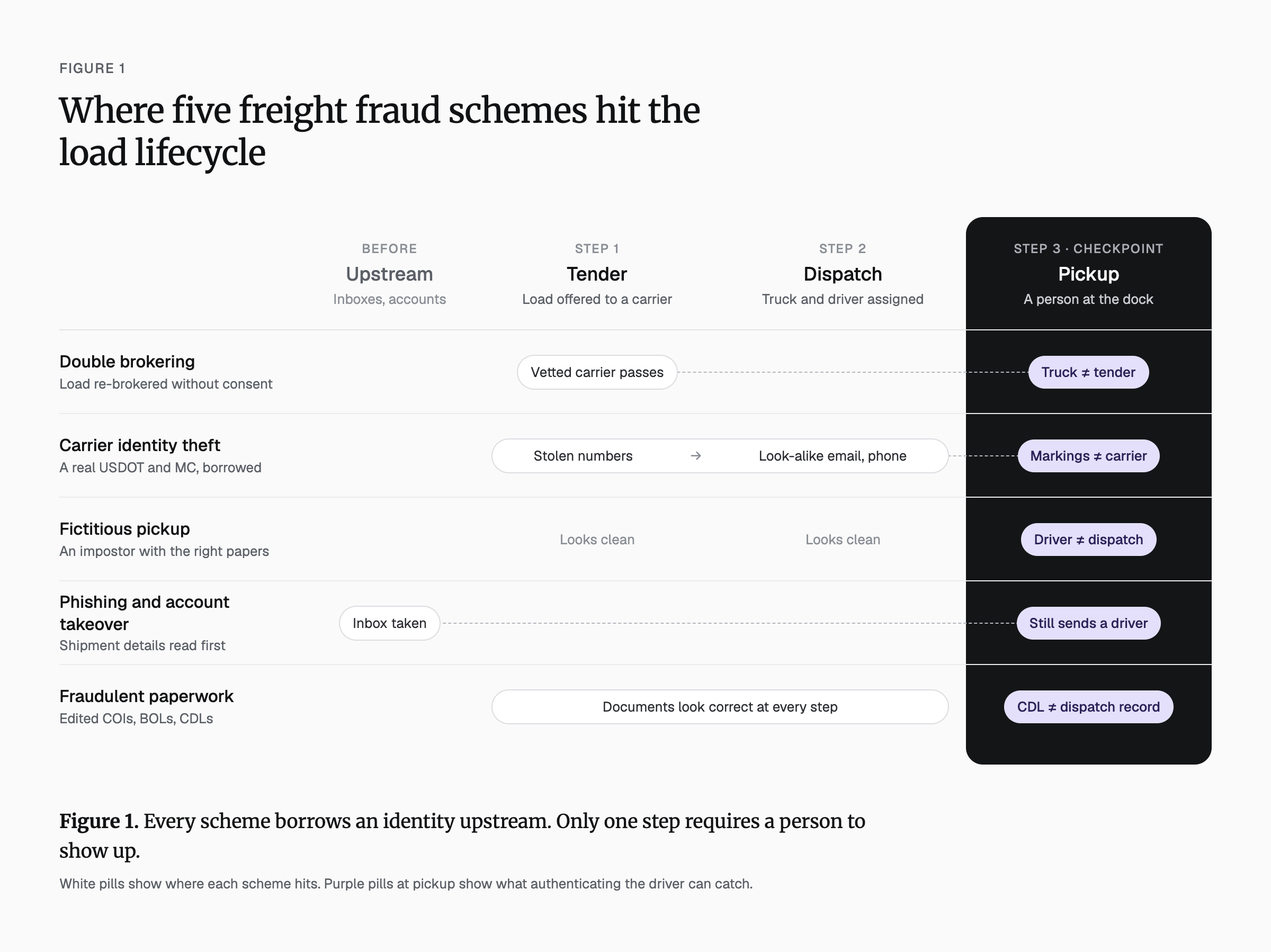
Almost every type of freight fraud runs on a borrowed identity that passes carrier vetting, and AI now makes that identity pass a phone call and a photo check too, so the control that still works is authenticating the person at pickup and keeping a record of it.
Five types of freight fraud brokers and shippers see most
Each scheme hits a different step in the load lifecycle. What they share is that the carrier record usually looks clean, because it belongs to a real company.
| Scheme | Load lifecycle step | What carrier vetting sees | Where it can still be caught |
|---|---|---|---|
| Double brokering | Tender | A legitimate carrier with authority and history | Pickup, when the truck and carrier on site don't match the tender |
| Carrier identity theft | Tender and dispatch | The real carrier's USDOT and MC numbers | Contact details that differ from the FMCSA record; markings at pickup |
| Fictitious pickup | Pickup | Nothing unusual; the load was tendered correctly | Pickup, by authenticating the person before release |
| Phishing and account takeover | Upstream of tender | Not in scope; the inbox is the weak point | Email security and callback procedures |
| Fraudulent paperwork | All steps | Documents that look correct | Checking documents against source data, not by eye |
Double brokering hands your load to a carrier you never approved
Double brokering is when a carrier, or someone posing as one, accepts a load and re-brokers it to another carrier without the broker's or shipper's consent. The carrier you vetted passes every check. The truck that arrives belongs to someone else.
Sometimes the second carrier is honest and the fraud is about payment. Sometimes it is the first step in a theft.
Warning sign: the carrier name, DOT number, or equipment at the dock doesn't match what was tendered.
Carrier identity theft borrows a real USDOT number, domain, or phone line
Carrier identity theft is when someone uses another carrier's USDOT number without authorization to book loads under that carrier's name. That is how the FMCSA defines it, and the agency notes that the real broker or carrier is often a victim too.
Thieves pair the stolen number with a look-alike email domain or a new phone line, so every database lookup comes back clean. Federal prosecutors have charged schemes built on fictitious carriers and brokers registered with real USDOT and MC numbers (U.S. DOJ, N.D. Illinois).
Warning sign: contact details that differ from the carrier's FMCSA SAFER listing.
Fictitious pickups put an impostor at the dock with the right paperwork
A fictitious pickup, also called a deceptive pickup, is when a thief poses as the assigned carrier or driver and leaves with the load. It happens at pickup, after every upstream check has passed.
In September 2026, two men posing as FedEx employees left a New Castle, Delaware warehouse with a trailer of electronics worth more than $680,000, using fraudulent licenses, documents, and a plate.
Warning sign: the person or truck at the facility doesn't match what was dispatched.
Phishing and account takeover give thieves the shipment details first
Account takeover is when a fraudster gains access to a broker's, shipper's, or carrier's email or load board account and uses it to read, redirect, or book freight. CargoNet calls business email compromise the primary access point for sophisticated theft schemes (Verisk CargoNet, Aug 2026).
Warning sign: an email asking to change contact, pickup, or remit-to details, even from a familiar address.
Fraudulent paperwork covers the gaps: COIs, rate cons, BOLs, CDLs, and cab cards
Fraudulent paperwork is any altered or fabricated document used to make a scheme look routine: a certificate of insurance, rate confirmation, bill of lading, commercial driver's license, or cab card. It shows up at every step.
These documents pass a visual check because they often start as real ones with a few fields edited. A doctored CDL looks like a CDL.
Warning sign: details that don't match each other, such as a license name that differs from the dispatch record or a cab card that doesn't fit the truck.
AI removes the tells that used to give fraud away
The FBI has warned that generative AI strips out the spelling errors and odd details that used to flag fraud, and that criminals use it to create fake driver's licenses, write phishing messages, and clone voices (FBI IC3, Dec 2024). In freight, that hits the checks brokers rely on most.
Voice cloning makes a call sound like the dispatcher or driver you expect
Voice cloning uses a short audio sample to generate speech in a specific person's voice. A callback that "sounds right" no longer proves who is on the line.
Generated documents and photos pass a quick visual check
Image tools can produce a license, a cab card, or a truck photo in seconds. One pattern E3 sees is a photo of a screen submitted in place of a live capture of a real document.
AI-written phishing arrives with no typos to catch
Phishing used to give itself away with clumsy writing. AI-written messages match the tone of a real shipper or carrier, which makes the email-compromise schemes above harder to spot.
Synthetic identities come with burner phones, disposable email, and masked locations
A synthetic identity combines real and invented details into a contact profile that holds together just long enough to book a load. E3 sees them arrive with VOIP numbers, disposable email addresses, and VPN-masked locations.
Phone calls and "it looks legit" checks now fail for the same reason
Every tactic above beats a person judging a voice, a photo, or a document. Those checks also leave no record. When a load goes missing, a phone call or a WhatsApp photo of a CDL gives an insurer or a court nothing to rely on.
The pickup is the one step a borrowed identity can't skip
Carrier vetting checks the company. A thief borrowing that company's name still has to send a person to the dock. That makes pickup the point where authentication belongs.
E3's Driver Authentication checks the driver at pickup, before the pickup number is released, and records the result. It checks 50+ fraud signals and returns a result in under 60 seconds. Across 700k+ loads and 5,000+ drivers authenticated per day, those signals map directly to the schemes above:
- Carrier identity theft: truck markings that don't match the carrier on the load, including a taped-on DOT number.
- Double brokering: a VIN or carrier on site that conflicts with what was tendered.
- Fictitious pickup: a driver switch revealed by a re-check at the facility.
- Fraudulent paperwork: license-status issues such as expired, temporary, or non-domiciled CDLs, which Shield flags 5 to 10 times a day so the SOP can route them for review.
The record matters as much as the catch. Shield replaces unrecorded calls and texts with controlled, auditable driver communication, so every handoff has an audit trail your SOPs, your insurer, and your legal team can point to. E3 also helps design the SOP itself: who sends what, when, and what triggers a hold.
See how Shield works here, or compare driver authentication tools here.
Four steps any brokerage or shipper can take now:
- Call carriers back on the number listed in FMCSA SAFER, never on the one provided.
- Release pickup numbers only after the person at the dock is authenticated.
- Keep a record of every driver interaction, not just the ones that go wrong.
- Report double brokering and identity theft to the FMCSA National Consumer Complaint Database.
Bring us your pickup SOP, and we'll show you where a borrowed identity gets through. Get in touch.
Caleb Sirak is Co-Founder and President of E3 Group.
- Freight fraud
- Cargo theft
- Double brokering
- Deceptive pickup
- AI fraud
- Driver authentication