· 9 min read
How does driver authentication work at pickup?
Carrier vetting tells you who owns the truck, not who's driving it. Here's how E3 driver authentication checks the driver, the credential and the truck before the pickup number goes out, and what record it leaves on the load.
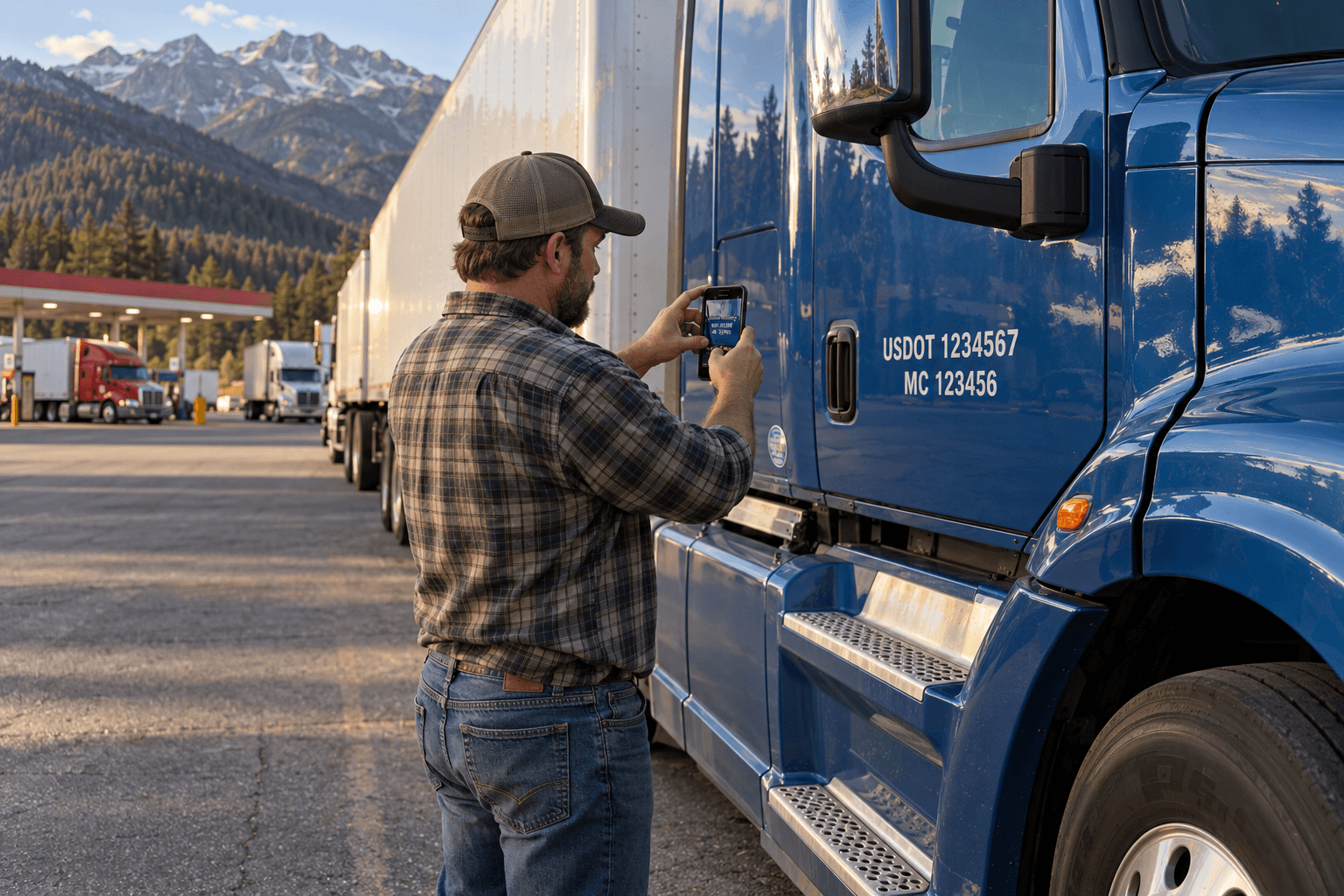
With E3 driver authentication, the driver gets a text link as soon as the load is assigned, takes live photos of their CDL, the side of the truck and the cab card, and finishes with a selfie. We check 50+ risk signals across those images, the phone and its location, and your team gets a go or no-go within a minute of the photos coming in, while the pickup number stays locked until the driver passes. Every step is logged against the load, so the check that runs before the truck moves also becomes the record you can show a shipper, an insurer or a court later.
Why check the driver if the carrier is already vetted?
Carrier vetting tells you who owns the truck, but it doesn't tell you who's driving it. A broker can confirm the MC number, the operating authority and the insurance certificate, and every one of those checks will pass when a thief is borrowing a legitimate carrier's identity, because the carrier itself is real. The weak point is the person who shows up for the freight, and in most brokerages that person is confirmed, if at all, through a phone call or a CDL photo sent by text.
Industry data shows what that gap costs. Verisk CargoNet recorded 2,646 cargo thefts in 2025, up 18% from the year before, with estimated losses of about $725 million, up 60%, and an average theft of $273,990. Fictitious pickups, where someone collects a load in person under a borrowed identity, are the scheme that plays out at exactly the point this post covers, and CargoNet counted 158 of them in the second quarter of 2026 alone.
Regulators already ask for part of this check. FMCSA's guidance on broker and carrier fraud tells shippers to "record tractor and trailer plate information and compare truck photos against carrier paperwork," but it says nothing about confirming who the driver is. Our view is that you need both checks, and that the driver check belongs in the same SOP as the truck check. For the schemes behind these numbers, see our guide to the types of freight fraud brokers face.
How does driver authentication work, step by step?
The flow has four steps, and your team doesn't have to start any of them. We've run it on more than 700,000 loads with zero stolen loads, and it authenticates more than 5,000 drivers a day across our customers.
Step 1. The load is assigned and the text goes out
When a driver is assigned to the load, E3 sends them a text with a link automatically, so no rep has to decide which loads get checked and every driver on every load gets the same request. Because the check runs at assignment, the result arrives well before pickup, which gives your team time to put a different carrier on the load if something is off. There is no app to download and no carrier enrollment, so coverage never waits on a carrier signing up for anything.
Step 2. The driver takes a few live photos
The link opens a simple web page that takes control of the phone's camera, and the driver takes live photos of their CDL, the side of the truck and the cab card, then a selfie, along with their phone number. Because every image is captured live, nobody can submit an old photo or an edited file from a camera roll. The flow can also include a short English proficiency check on video, and 96% of drivers complete the whole thing, which we cover in more detail in why 96% of drivers complete E3 driver authentication.
Step 3. E3 checks 50+ risk signals
Once the photos are in, we score more than 50 risk signals together, and they fall into four groups covering the credential, the person, the truck and the phone.
- The credential. We read the barcode on the back of the CDL and match it to the front, look for signs of a doctored license, and flag non-domiciled and limited-term CDLs. FMCSA's non-domiciled CDL final rule narrowed who can hold one when it took effect on March 16, 2026, and our post on the non-domiciled CDL rule covers what brokers can catch.
- The person. Patent-pending biometric face match and liveness confirm that the selfie belongs to the person on the CDL. When the English proficiency check runs, the face in the video is matched with the CDL as well, which matters because a driver who fails an English proficiency check at roadside is placed out of service under CVSA's out-of-service criteria, and our English language proficiency post explains what that does to a load.
- The truck. Our vision models cross-check the VIN and the MC and DOT numbers across every image, and they catch magnetic decals and paper taped over a truck's identifiers, which standard OCR tends to miss.
- The phone. Phone, email, IP and device location signals fill in the rest, including VPN and VoIP flags, so a link sent for a pickup in Texas but opened in Kentucky stands out right away.
These are models we purpose-built for freight fraud rather than a general chatbot reading a photo, and Built on bare metal explains what sits underneath them.
Step 4. Your team gets a go or no-go, with proof
Within a minute of the driver submitting their photos, the result lands in Slack or Teams as a go or no-go with a risk score and the reasons behind it, so your team sees the decision in the channel it already watches. When the driver passes, E3 can release the pickup number for you once the driver is at the pickup location. When something is off, the number stays locked and the flag tells your team which signal failed and why.
What happens when a driver is flagged?
A flag stops the release of the pickup number, but it doesn't make the decision for you. Your team sees which signals failed and the images behind them, and the broker always makes the final call, whether that means asking the driver to retake a photo, escalating to compliance or moving the load to another carrier. Permissions can be set differently for brokers, management and compliance teams, and any manual override is documented in the authentication record.
One flag from our records shows what this looks like in practice. We once flagged a CDL that had been photographed off a tablet screen rather than taken from a physical card, and while the image looked like a license at a glance, the live-capture check caught it and sent the flag to the broker before the pickup number went out.
Most drivers never get stuck at this stage, since 96% complete authentication. The roughly 4% who don't are worth a closer look, because in our experience that group often shows early signs of potential fraud, which is why an unfinished authentication is a reason to look harder at the load rather than a paperwork delay to wave through.
What if the driver changes between booking and pickup?
A driver who authenticates at assignment has to be the same person who arrives for the freight, so the check doesn't end with the first result. The pickup number is released when the driver is at the pickup location, and a re-check there catches a driver switch between booking and pickup. We have seen this happen, with the re-check at the pickup location catching a different driver arriving for a load.
Shippers get a view of this too. With the shipper handoff, the broker sends the shipper the truck photo and driver selfie they should expect at the dock, so the receiving team knows who is coming before the truck pulls in. For a shipper that owns the freight and carries the loss, that turns the dock check from a guess based on a carrier name into a comparison against an authenticated driver and truck, backed by the broker's full record.
What record does driver authentication leave?
Every message, photo and decision is logged against the load, including the result, the reasons behind any flag, our support team's outreach to the driver and any override your team makes. Brokers can check the status of any authentication at any time, from not started and in progress through to passed or failed. That record replaces the phone calls and email threads most brokerages rely on today, which aren't logged, don't run the same way on every load and are hard to defend after a loss.
We help customers write the SOP that governs driver communication and then build it into the flow, so the check runs identically in peak season and in a slow week. When a customer, an insurer or a court asks what you did before releasing the load, the answer is a dated entry in the record rather than one person's memory of a phone call.
That question is getting sharper. In May 2026 the U.S. Supreme Court ruled 9–0 in Montgomery v. Caribe Transport II that the FAAAA does not preempt state negligent-selection claims against brokers. The case concerned carrier selection after a crash rather than theft or driver identity, and the Court did not require brokers to check drivers. In our view, though, it means brokers should expect to be asked what they checked before a load moved, and a logged, SOP-driven record is the clearest way to answer. Our post on why your driver conversations are evidence now makes the full legal argument.
What does the driver experience look like?
For the driver, authentication is a link, a few photos and a selfie on a phone they already carry, with no app to install and no interrogation over the phone. Drivers consent to photo capture and temporary location capture on the form's first page, and E3 deletes personal information after essential use. If a driver gets stuck, our support team helps them through it around the clock, and the broker still decides what happens to the load.
We built it this way because thieves steal real drivers' names and CDL numbers to take freight, so a check that shows the real driver is standing at the truck protects that driver's identity as much as it protects the broker and the shipper.
Frequently asked questions
Does driver authentication replace carrier vetting?
No. Carrier vetting checks the company, while driver authentication checks the person who shows up for the load, and in our view you need both.
Do carriers need to enroll, or drivers need an app?
Neither. E3 works without carrier enrollment, and drivers complete authentication from a text link that opens a web page on their phone.
How long does it take?
The risk score comes back within a minute of the driver submitting their photos.
Can I share results with my shipper?
Yes. You can send your shipper the truck photo and driver selfie they should expect at the dock, backed by the full record on the load.
How fast can we start?
E3 integrates with your TMS and can be up and running in one day, with decisions delivered in Slack or Teams.
Before your next high-value load goes out, look at how your team confirms the driver today, whether that's a phone call, a CDL photo sent by text or nothing at all, and ask whether that step would hold up if a shipper or an insurer asked to see it. If the answer is no, the first fix is to tie the pickup number to a step the driver has to complete and to write that step into your SOP.
Backed by our 100% fee-refund promise. If a theft occurs on an E3-authenticated shipment, we refund every fee paid to date.
See what your team would see on a real load. Book a demo
- Driver authentication
- Cargo theft
- Fictitious pickups
- Compliance